

Table of Contents
- Quick Comparison: Small Desk Organisation Solutions
- Desk Cable Management Solutions That Actually Work
- Vertical Desk Storage: Make Use of Every Centimetre
- How to Declutter a Workspace: A Step-by-Step Approach
- Best Ways to Organize Small Desks: Products That Earn Their Place
- What to Avoid When Organising a Small Desk
- Conclusion
- Frequently Asked Questions
Last Updated: 11 September 2026
Quick Comparison: Small Desk Organisation Solutions
The best ways to organise small desks start with matching the fix to the problem: cables, vertical space, or daily clutter. This guide from Speid's Shop breaks down each category so you can buy once and stop reshuffling the same mess every weekend.
Small desk organisation is the practice of assigning a fixed place to every item on a compact work surface, then using vertical and under-desk space to keep that surface clear. A standard desk gives you roughly one square metre of working area (hse.gov.uk). Everything you add either earns its footprint or steals it.
Below, we cover the three categories that actually solve small-desk problems, plus the products from our own range that earn their place. The Health and Safety Executive workstation guidance is worth a read if you spend long hours at your desk, since a cluttered setup often pushes your screen and keyboard into poor positions.
Desk Cable Management Solutions That Actually Work
Desk cable management solutions fall into two groups: adhesive fixes that route cables along surfaces, and charging hardware that removes cables altogether. Start with the second group if you can afford to, because fewer cables means less to manage.
Reusable Tape and Adhesive Clips
Adhesive clips and reusable tape are the cheapest fix and the one most people get wrong. Cheap foam pads fail within weeks on painted or varnished surfaces. A reusable double-sided tape, like the Double Sided Reusable Tape at £5.99, holds clips, cable channels and small hubs without marking the desk when you move things around.
Run cables along the back edge of the desk, not across the middle. Group them with clips every 15-20cm. Leave a service loop near each device so you can unplug without pulling the whole run loose.
Charging Stations That Reduce Cable Clutter
A charging station removes the tangle at source. Instead of three cables fighting for two sockets, one device charges your phone and lights the desk. The Charger Lamp at £49.99 combines a 15W fast charger with an adjustable lamp you control through an app, so it replaces both a bedside-style lamp and a charging cable.

Vertical Desk Storage: Make Use of Every Centimetre
Vertical desk storage moves items off the work surface and onto the wall or the back edge of the desk. On a compact desk, the wall above your monitor is the largest unused asset you own.
Wall-Mounted and Clip-On Options
Wall-mounted shelves and clip-on organisers free up the surface without adding footprint. Before drilling anything, check what your wall will take: plasterboard needs proper fixings, and rented accommodation usually rules out drilling altogether. Clip-on options that grip the desk edge are the safer choice for students and renters.
Measure the depth of your desk before buying anything wall-mounted. A shelf that overhangs your chair's clearance is worse than no shelf at all.
Multi-Purpose Devices That Save Desk Space
The most effective space-saving move is buying one device that does two jobs. A lamp that charges a phone takes one footprint instead of two. A dispenser that replaces a water bottle and glass does the same.
The Desktop Water Dispenser at £44.99 is rechargeable and measures how much water is left, so you stop keeping a bottle, a glass and a coaster on the desk. It is a small change that removes three objects from your surface.
How to Declutter a Workspace: A Step-by-Step Approach
Learning how to declutter a workspace is mostly about deciding what leaves, not what stays. Work in this order and you will finish in under an hour.
- Clear the entire surface, including the monitor stand and anything behind it.
- Sort everything into three piles: daily use, weekly use, and everything else.
- Put the "everything else" pile in a box and store it out of sight.
- Wipe the surface, then return only the daily-use items.
- Assign each returned item a fixed position and mark it if needed.
- Route all cables along the back edge and secure them.
- Set a timer and repeat the surface clear once a day.
The 10-Minute Daily Reset
The ten-minute daily reset is the habit that keeps a small desk usable. At the end of each working day, return loose items to their assigned spots, wipe the surface, and clear any cups or packaging.
Ten minutes sounds generous. In practice, most people finish in three or four once the desk has a defined home for everything.
| Problem | Fix | Time Needed | Frequency |
|---|---|---|---|
| Cable tangle | Adhesive clips plus reusable tape | 20 minutes | Once |
| Surface clutter | Fixed position for each item | 10 minutes | Daily |
| No storage space | Wall-mounted or clip-on organiser | 30 minutes | Once |
| Cold feet under desk | Under-desk foot heater | 5 minutes setup | Seasonal |
| Paper pile-up | Reusable note board | 5 minutes | Daily |
Best Ways to Organize Small Desks: Products That Earn Their Place
The best ways to organise small desks are the ones that remove an object rather than add one. Every product below replaces something you already own, so your desk ends up with fewer items, not more.
Under Desk Electric Foot Heater: Comfort in a Compact Package
Cold feet are an underrated reason people abandon a home desk in winter. The Under Desk Electric Foot Heater at £54.99 folds flat when not in use, runs silently, and includes a thermostat, timer and auto shut-off that triggers if the unit tilts. It comes in grey and pink and weighs under a kilogram. Check the product's stated temperature rating for safe use.

Pros: folds away, silent, safety cut-off, timer for energy control. Cons: seasonal use only, so it needs somewhere to live in summer.
Charger Lamp: Light and Power in One Footprint
Two devices, one base. The Charger Lamp at £49.99 gives you an app-controlled light and a 15W phone charger on the same deck. Place the phone on the charging surface and adjust brightness from your phone.
Pros: removes a separate lamp and cable, doubles as an alarm. Cons: you need the app to get the most from the lighting.
LED Note Board and LCD Calculator: Notes Without the Paper Pile
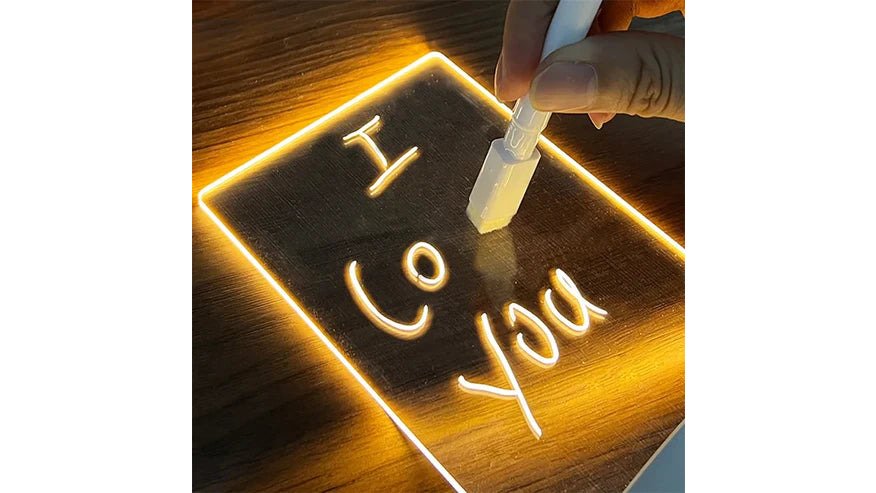
Paper is the fastest way to lose a small desk. The LED Note Board at £19.99 lets you write and erase without a single sheet, and the LCD Calculator at £24.99 pairs a calculator with a writing panel so your workings stay on one device.

Pros: no paper waste, instant erase, compact. Cons: not a replacement for long-term record keeping.
What to Avoid When Organising a Small Desk
The most common mistake is buying storage before sorting. Boxes, trays and organisers add volume to a desk that is already short of space, and most people fill them with items they never touch.
Other traps worth avoiding:
- Drilling into rented walls without permission. Use clip-on or freestanding options instead.
- Cheap adhesive pads that fail and leave residue on varnished surfaces.
- Monitor risers with built-in storage that block your keyboard clearance.
- Buying by aesthetic alone. A beautiful tray that holds nothing useful is just clutter with a nicer finish.
- Ignoring cable routing during setup. Retrofitting cable management means unplugging everything again.
Conclusion
A small desk fails for predictable reasons: cables multiply, paper accumulates, and every new gadget takes space without giving any back. Fixing it means choosing products that replace what you already own rather than adding to it.
Speid's Shop stocks the pieces that do exactly that, from the foldable Under Desk Electric Foot Heater and the dual-purpose Charger Lamp to the paperless LED Note Board. Every order comes with free shipping, free returns, a 30-day return policy and 100% secure payments, backed by a 5.0 platform-wide review score.
Order now and give your desk the space back.
Frequently Asked Questions
How do you organise a desk with no drawers?
Use vertical desk storage instead of horizontal surfaces. Wall-mounted shelves, clip-on organisers, and stackable trays keep stationery and devices off the desktop. A multi-purpose device like the Charger Lamp (£49.99) combines lighting and phone charging in one footprint, removing the need for separate drawer space. Reusable double-sided tape (£5.99) can fix lightweight organisers to the side of your desk or wall without drilling. The key is to move items up and off the desk surface, not into drawers you do not have.
What are the best space-saving desk accessories?
The most effective space-savers combine two or more functions. The Charger Lamp handles both lighting and phone charging, so you remove a separate lamp and charging cable from your desk. The LCD Calculator (£24.99) replaces a standard calculator and a notepad with one device. The Under Desk Electric Foot Heater (£54.99) sits below the desk and folds flat when not in use, so it takes up zero desktop space. Look for items that replace two or three single-purpose objects rather than adding another gadget.
How do I manage cables on a small desk?
Start by reducing the number of cables you need. A wireless charger like the Charger Lamp eliminates one charging cable entirely. For remaining cables, use reusable double-sided tape (£5.99) to route them along the underside or back edge of your desk. Adhesive clips work well for thinner cables. Group cables that run to the same area and secure them together. If you use a portable printer (£54.99), keep its cable coiled and taped to the back of the desk when not in use. Fewer cables means less visual clutter.
How can I keep my small desk tidy without clutter?
Follow a daily reset routine. At the end of each work session, spend two minutes returning items to their designated spots. Items without a fixed home will always become clutter. Use a vertical storage system so every object has a place: pens in a clip-on cup, notes on an LED Note Board (£19.99) instead of loose paper, and charging equipment on a single charging deck. If something has not moved from your desk in a week, it probably does not belong there. A desk with fewer objects is easier to keep tidy.
Where should I store stationery on a small desk?
Keep stationery within arm's reach but off the main work surface. Clip-on cups attached to the desk edge, wall-mounted magnetic strips, or a slim vertical tray at the back of the desk all work well. The LCD Calculator (£24.99) lets you take notes directly on its panel, which reduces the need for loose pens and paper. If you have a portable printer (£54.99), keep paper stored underneath it or in a slim folder beside it. The goal is to keep the central 40-50 cm of your desk completely clear for your laptop or main task.


