

Table of Contents
- What You'll Need for This Guide
- Why Charging Cables Fail: Common Causes of Damage
- How to Prevent Cable Fraying: Daily Habits That Matter
- Proper Cable Storage: Where and How to Keep Them
- Charging Habits That Extend Cable and Battery Life
- Signs of a Faulty Charging Cable: When to Stop Using It
- Charging Cable Protection Accessories Worth Buying
- Final Thoughts on Maintaining Charging Cable Longevity
- Frequently Asked Questions
Last Updated: September 9, 2026
What You'll Need for This Guide
Maintaining charging cable longevity is simpler than most people think, and it starts with understanding a few basic principles about how cables actually fail. Before we get into the habits that protect your cables, gather a few inexpensive items: a soft cloth, a small cable pouch or organiser, and ideally a cable with a braided exterior rather than a thin plastic one. You do not need specialist tools or technical skill; this guide focuses on practical, everyday actions that take seconds but add months of life to your accessories.
The most common reason cables end up in the bin is damage at the connector joint, not along the wire itself. That single point absorbs nearly all the stress from daily use, which means protecting it should be your primary goal. Below, we will show you exactly how to build habits that prevent fraying, store cables properly, and recognise when a cable is no longer safe to use. These strategies take minimal effort and cost nothing to implement.
Why Charging Cables Fail: Common Causes of Damage
Most cable failures trace back to three avoidable behaviours: pulling the cable out by the wire, bending it sharply at the connector, and leaving it tangled under stress. When you yank a cable from a socket by its cord, you stretch the internal copper strands and weaken the insulation where it meets the plug. Over time, this creates micro-fractures that eventually expose the wires inside.
Sharp bending is equally damaging. Cables are designed to flex gently, not to fold at tight 90-degree angles repeatedly. Think about how you use your phone in bed or on the sofa; if the cable is constantly kinked against a pillow or cushion, you are accelerating wear with every movement. The internal shielding that protects data and power transfer degrades when compressed or bent beyond its limits.
A third culprit is environmental stress. Heat, direct sunlight, and moisture all break down the outer jacket of a cable, making it brittle and prone to cracking. Leaving a cable draped across a radiator or stuffed in a hot car boot shortens its lifespan considerably. For more detail on the physical stresses that damage electronics, the guidance on electrical device care from the UK Health and Safety Executive offers a useful technical background on how insulation degrades.
How to Prevent Cable Fraying: Daily Habits That Matter
How to prevent cable fraying comes down to small, consistent actions rather than occasional dramatic interventions. The single most effective habit is to grip the connector, not the wire, whenever you plug or unplug a device. This one change removes the stress that causes most fraying at the joint.
The Right Way to Unplug
Place your thumb and forefinger firmly on the plastic or metal connector head, right where it meets the port. Pull straight out with even pressure, keeping the cable parallel to the socket. Do not twist or wiggle the connector side to side; that loosens the internal solder points and widens the gap where the wire enters the plug. When unplugging from a wall adapter, hold the adapter itself with your other hand for stability.
Coiling vs Folding: Which Is Safer?
Loosely coiling a cable is always safer than folding it in half. Folding creates a sharp crease at the same point every time, which eventually cracks the insulation. To coil properly, make a loop roughly the size of your fist, then wrap the cable around your hand and elbow in a figure-eight pattern. This over-under method prevents twists and keeps the internal wires aligned. Secure the coil with a Velcro strap or a simple twist tie, never a tight rubber band, which can crush the insulation.
Proper Cable Storage: Where and How to Keep Them
Storing cables correctly is the half of maintaining charging cable longevity that most people skip. The ideal storage environment is cool, dry, and free from heavy objects pressing down on the cable. A desk drawer with a few small organisers works perfectly; the key is that each cable has its own space and is not tangled with others.
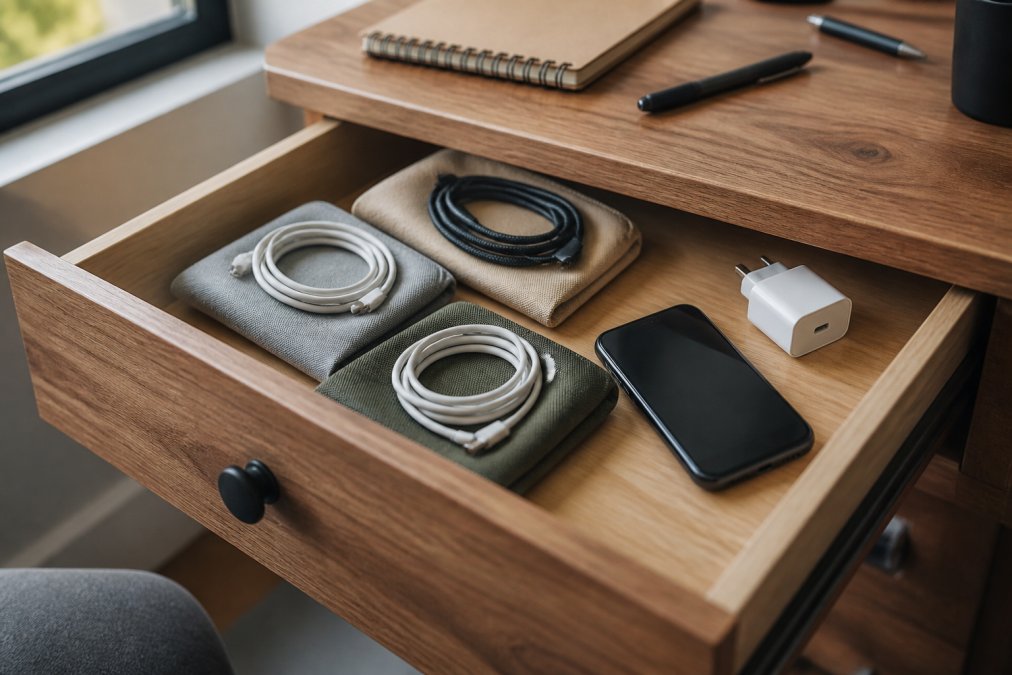
Avoid hanging cables from hooks by their connector heads, as gravity pulls on the joint over time. Likewise, do not leave cables plugged into wall adapters permanently; the adapter continues to draw power and generates heat even when no device is attached. For a deeper look at how heat affects electronic components and insulation, research on thermal degradation of polymer insulation explains why consistent moderate temperatures protect cable materials far better than fluctuating ones.
A practical system is to dedicate one small pouch or compartment per cable, labelling it if you own several. This prevents the tangle-and-yank cycle that happens when you are in a hurry and just pull whatever comes out of the drawer.
Charging Habits That Extend Cable and Battery Life
Your charging routine affects both the cable and the device battery. Avoid charging overnight on a regular basis, as keeping a battery at 100% for hours generates heat that stresses both the battery chemistry and the cable's connector. Unplugging once the device reaches full charge, or using a smart plug with a timer, reduces unnecessary heat exposure.
Another habit worth adopting is to avoid using your phone heavily while it is charging. Gaming or streaming video while plugged in draws maximum current, which heats the cable and the port simultaneously. This combined heat is a leading cause of connector damage. If you must use the phone, keep the cable away from your body so it can dissipate heat, and try not to bend it sharply while holding the device.
Partial charging is gentler on your equipment than full cycles. Keeping a battery between 20% and 80% reduces strain on both the battery and the charging circuitry. This approach is supported by general battery chemistry guidance; the battery care advice from the University of Cambridge notes that avoiding extreme charge states extends the usable life of lithium-ion cells.
Signs of a Faulty Charging Cable: When to Stop Using It
Recognising signs of a faulty charging cable is essential for both safety and device protection. A cable that is frayed, shows exposed wires, runs hot to the touch, or only charges when held at a certain angle should be retired immediately. These are not minor inconveniences; they indicate internal damage that can cause short circuits or overheating.
The most dangerous sign is visible copper wire or blackened spots on the connector. At this point, the cable's insulation has failed, and continued use risks damaging your phone's charging port or, in rare cases, causing a fire. Do not attempt to patch a damaged cable with electrical tape as a long-term fix; tape hides the problem but does not restore the internal shielding.
Other warning signs include intermittent charging, slow charging despite using the correct adapter, and a loose connection that requires you to wiggle the plug. If your cable exhibits any of these, replace it promptly. The cost of a new cable is far lower than the cost of repairing a damaged device port or dealing with an electrical fault. When you do replace it, choosing a braided cable with reinforced joints reduces the frequency of future replacements.
Charging Cable Protection Accessories Worth Buying
Charging cable protection accessories range from simple strain relief springs to complete braided replacements, and a few are genuinely worth the money. A strain relief spring or silicone sleeve that fits over the connector joint adds flexibility at the exact point where cables typically fail. These cost very little and are easy to fit on existing cables.
Cable organisers and pouches are another worthwhile purchase, particularly if you carry cables between home and work or keep spares in a bag. A simple fabric pouch prevents tangling and protects the cable from abrasion against other items in your bag. For those who want a more permanent solution, cables with a woven nylon or Kevlar exterior are significantly more resistant to fraying and everyday wear than standard PVC cables.
For a cable that is less likely to fail in the first place, consider a charging bracelet. The Speid's Shop charging bracelet combines a high-quality braided exterior with rapid charging technology, so you get a durable cable that also functions as a wearable accessory. It addresses the root cause of cable failure, weak construction, while keeping your phone powered on the go.
Final Thoughts on Maintaining Charging Cable Longevity
The principles behind maintaining charging cable longevity are straightforward: handle connectors gently, coil loosely, store in a cool dry place, and replace anything that shows signs of internal damage. Most cables fail because of accumulated micro-stress at the joints, not because of a single dramatic event. By adopting the daily habits outlined here, you can realistically double or triple the life of every cable you own.
At Speid's Shop, we understand that small frustrations like a frayed cable disrupt your day more than they should. That is why we focus on practical accessories that genuinely solve everyday problems, backed by free delivery, free returns, and a 30-day return policy if a product does not fit your routine. Our platform-wide reviews reflect a 5.0 rating from customers.
Get started with Speid's Shop and find a charging solution that keeps your devices powered without the constant cycle of replacement.
Frequently Asked Questions
Why do my charging cables keep breaking at the end?
The point where the cable meets the connector bears the most stress. Pulling the cable itself instead of the plug, bending it sharply, and letting the connector dangle under its own weight all strain this weak spot. Over time, the internal wires fatigue and the outer insulation splits. To protect this area, grip the plug firmly when disconnecting and avoid bending the cable at tight angles near the connector.
Is it better to coil or fold charging cables?
Coil charging cables loosely rather than folding them sharply. Folding creates creases that stress the internal wires and weakens the insulation over time. When coiling, use an over-under technique or simply wrap the cable in a wide loop around your hand and elbow. Avoid tight wraps around small objects like a pen, as this puts continuous pressure on the cable. Store the coiled cable in a pouch or use a velcro strap to keep it tidy.
How can I tell if a charging cable is damaged and unsafe?
Look for visible fraying, exposed wires, bent connectors, or discolouration. If the cable feels unusually warm during charging, sparks at the connection, or charges intermittently when you wiggle it, stop using it immediately. A damaged cable can damage your device's battery or pose a fire risk. The safest approach is to replace it as soon as you notice damage. Check regularly, especially near the connector ends.
Does the quality of a charging cable affect its lifespan?
Yes, quality makes a noticeable difference. Cables with thicker insulation, reinforced connector joints, and durable braided exteriors withstand daily wear far better than cheap, thin alternatives. High-quality cables also use better conductors, which reduces heat build-up during charging. Heat is a major enemy of cable longevity. Investing in a well-made cable, such as one with a high-quality braid, costs a little more upfront but saves money in the long run.


